



 2 Photos

George Iorio and Merrill Barett. COURTESY VINNY MANGANO
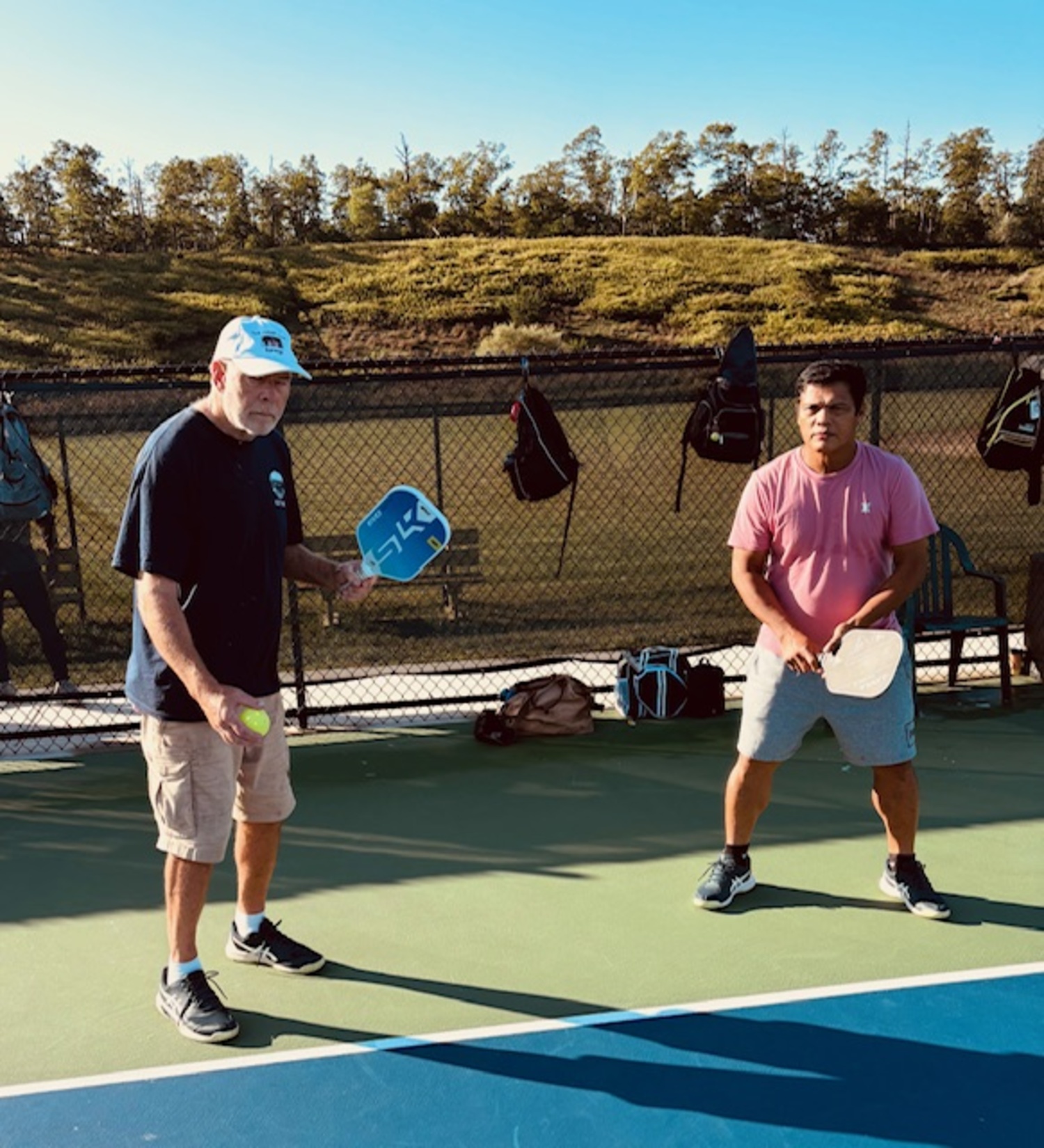
Paton Miller and Domingo Tiozon. COURTESY VINNY MANGANO

Playing doubles pickleball well means learning how to work as a team. Good communication during a volley is one of the most important skills you can develop if you want to win more points than your opponents.
One big difference between tennis and pickleball is how partners position themselves on the court. A tennis court is much larger, so one player often stays back to cover the baseline, while the other moves up to the net.
Pickleball, on the other hand, is played on a smaller court. The goal is for both players to move forward together and form a strong “pickle wall” at the kitchen line — the line close to the net. When defending, both players may need to stay back near the baseline until they can safely move forward.
Whether you’re deep in the court or up at the kitchen line, one of the most important questions is: Who covers the middle?
Pickleball nets are slightly lower in the middle — 34 inches, compared to 36 inches at the sidelines. That 2-inch difference makes it easier to hit safely through the middle than to risk a passing shot down the line. And since a pickleball court is only 21 feet wide, those down-the-line attempts don’t leave much room for error.
Now, let’s look at an example with two right-handed players. In this setup, the left-side player has his or her forehand in the middle. That usually makes them the more aggressive partner on balls that come down the middle. The right-side player often plays a supporting role, keeping the rally going and setting up their partner for finishing shots.
Both players should move side-to-side as a unit, but if the ball comes directly down the middle, the forehand — usually the left-side player — takes it.
Another option is to “play the X.” With this strategy, the player diagonally opposite the hitter takes the middle ball. So, if your opponent on their left side hits it, your right-side player covers. If their right-side player hits it, your left-side partner steps in. This method can make decision-making easier, especially against opponents who like to dink side to side.
Things get trickier if your team has one right-handed and one left-handed player. If the lefty plays on the right side and the right-hander on the left, both players’ forehands cover the middle — that’s a big advantage. But if they switch sides, both players now have their backhands in the middle, which is much harder to defend.
That’s where stacking comes in. Stacking means both players start on the same side of the court before the serve. After the serve, one player slides over, so the team ends up with both forehands in the middle. Teams can also stack when receiving, but that takes more coordination and practice. Either way, the key is making sure players start on the correct side before moving.
Even professional teams use stacking. Sometimes a team will stack just to keep a stronger player on the left side, even if both are right-handed. But for recreational players, it’s best to keep things simple unless both partners are comfortable with it.
Personally, when I play with a left-handed partner, I like to ask if they want to stack when we serve. It’s usually easy to learn, and it can make solving the “riddle of the middle” much simpler.
No matter what strategy you use — forehand takes the middle, play the X, or stack — the most important thing is to talk it through with your partner before the game begins. That way, you’ll both know who’s covering the middle, and you’ll spend less time guessing and more time winning points.
QUICK TIPS:
Covering the Middle in Doubles
• Forehand Takes the Middle: The player whose forehand faces the middle (usually the left-side player if both are right-handed) covers the middle ball.
• Play the X: The player diagonally opposite the hitter takes the middle shot.
• Stacking: Partners start on the same side so both forehands can cover the middle. More advanced, but helpful when playing with a lefty.
No matter which system you use, always communicate with your partner before the game.
More Posts from Vinny Mangano


