


 2 Photos
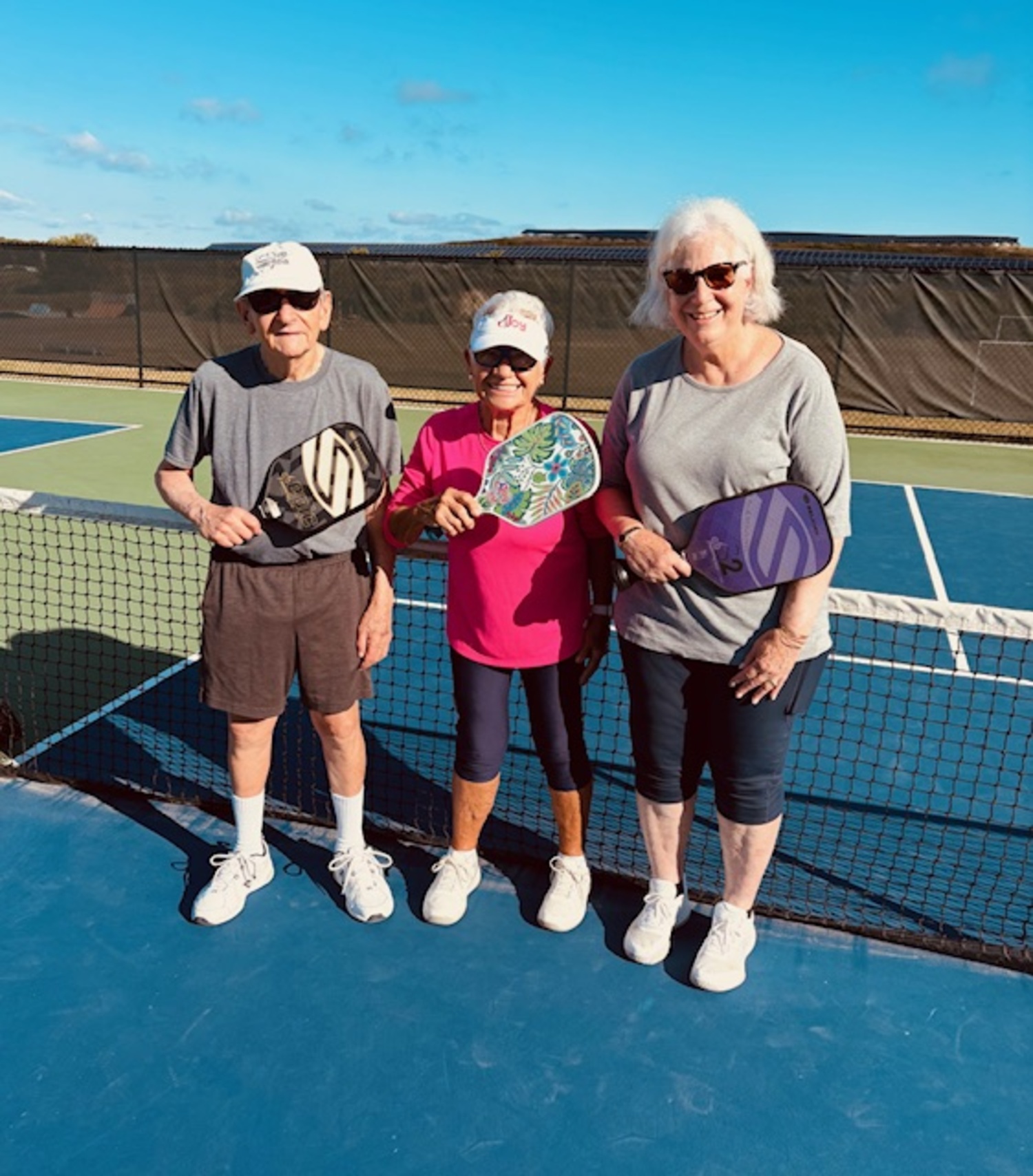
Pickleballers Sam Rortbart, left, Frederique Francois and Billie Swarztrauber. COURTESY VINNY MANGANO
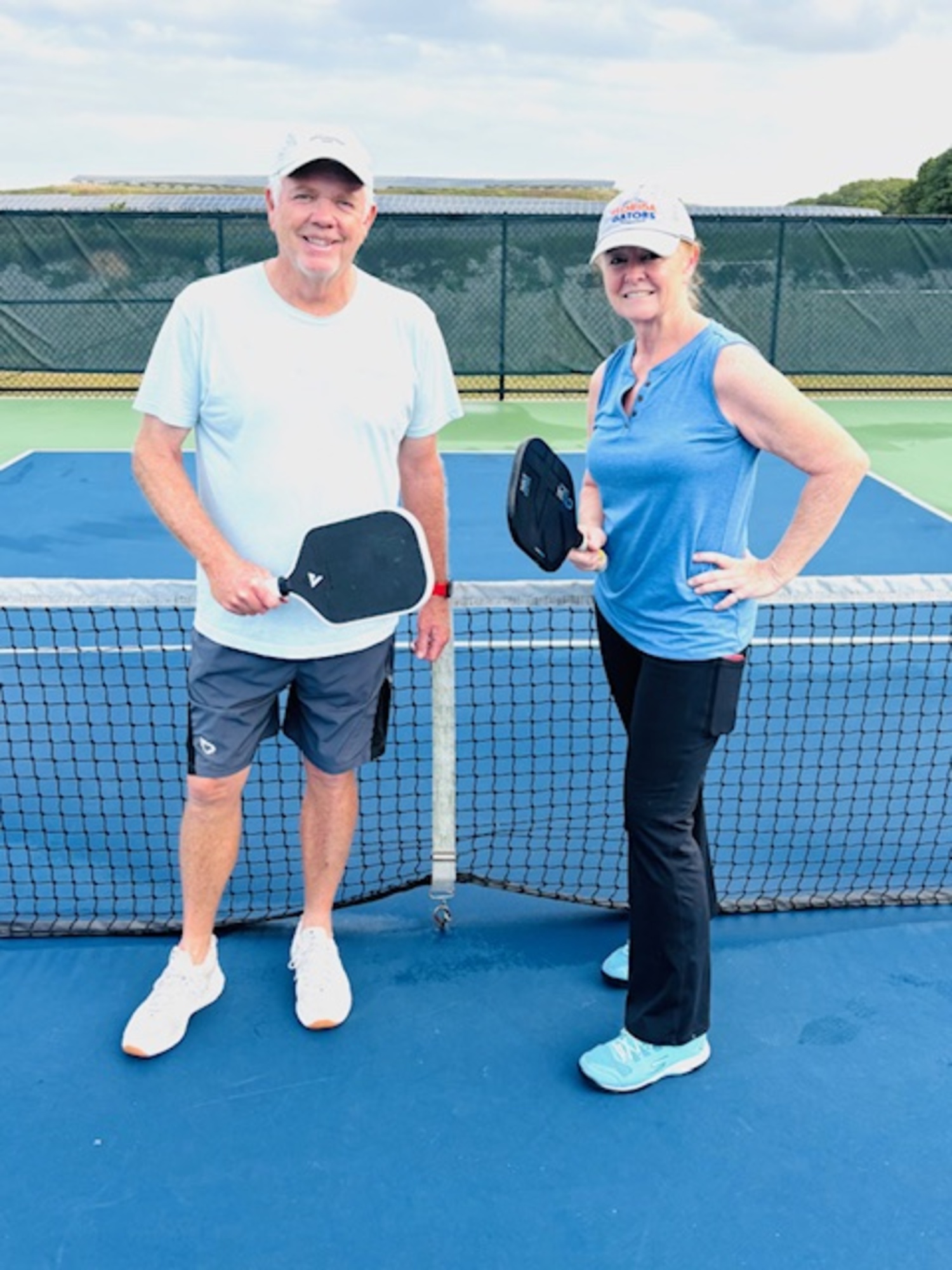
Pickleballers Scott Johnston and Kiera Fitzgerald. COURTESY VINNY MANGANO
Many pickleball players ask me: Where did the name “pickleball” for the game we love come from?
The name pickleball was given to the sport by Joel Pritchard’s wife, Joan, who thought it resembled the “pickle boat” in crew — a boat filled with leftover rowers from other teams.
That’s the true story and not very exciting. The more popular story is that Joel and Joan had a dog named Pickles, and he would fetch the balls. But Pickles came later and was named after the game.
You can use either version, but the truth never hurts.
Pickleball has a few unique and unusual terms that you may or may not have heard, or if you have heard them you might have no idea what they mean. Let’s start with the “no fly zone,” aka “the kitchen.”
One of the three most important differences between tennis and pickleball is the no fly zone, or kitchen, which is the rectangular area from the net to your service box. It’s 7 feet wide, and you cannot volley an opponent’s shot out of the air if your feet are in that rectangle. You can’t step into the kitchen or lose your balance and fall into the kitchen.
Many pickleball historians feel that Joel and Joan borrowed “kitchen” from shuffleboard, which has a penalty zone called the kitchen. Since hitting a fly while in the kitchen costs your team the point, I always say: Keep out of the kitchen — it’s too hot in there.
“Dinking” is another term which is unique to pickleball. Since your opponent cannot step into the kitchen and volley the shot out of the air, hitting a low soft shot that bounces in their kitchen is very effective. The goal is to move your opponent laterally and, hopefully, force him or her into popping the return high in the air, allowing your team to put it away.
Dinking is an advanced strategy and really makes the game a chess match between the two teams. Patience is a virtue while involved in a dinking battle. Dink responsibly.
“Around the post” is one of the most satisfying shots you can execute while playing a game. When your opponent hits an angle shot that moves you outside the court, you are allowed to hit the ball around the post and have your shot land inside your opponent’s side of the court. As in tennis, the ball doesn’t have to pass over the net on a fly — it simply must be hit on the first bounce and land inside your opponent’s court.
Another great shot is called an “Erne.” It’s named after Erne Perry, who was the first to execute it successfully in a tournament.
The player starts with both feet on his or her side of the kitchen line, and, as the ball travels over the net, the player jumps over the kitchen diagonally and must land with both feet out of bounds. The player volleys the ball out of the air and hits a hard, low shot to win the volley. You can also run through the kitchen, but before you hit the ball, both feet must be established out of bounds.
This is a very difficult shot and needs to be practiced in order to legally and safely execute it.
With the explosion of professional pickleball leagues and tournaments, two controversial shots have come into play.
If you “body bag” your opponent, you intentionally hit your shot directly at your opponent’s body to win the point. Most players frown on this intentional targeting of your opponent. This year, if your shot is targeted at your opponent’s head, you lose the point and are given a warning.
Recreational players generally do not body bag and usually apologize after the ball accidentally strikes an opponent. This is a good reason for all players to wear protective glasses while playing pickleball.
A “nasty Nelson” is another shot that is frowned upon and, hopefully, not seen on any of the recreational courts you may be playing on.
The server is only 28 feet from the nonreceiving opponent who is directly across from him. The server intentionally serves the ball hard and targets that nonreceiving player, and hits him with the serve. By rule, the server wins the point.
Recreational players accidentally hit the nonreceiving player occasionally, but this is not done on purpose. If I’m playing recreationally and I see these shots, those are players I avoid.
The “third shot drop” is one of the most effective shots in pickleball and requires constant practice and patience.
Since pickleball requires the ball to bounce once on each side of the court before either team can volley it in the air, the third shot is vital for the serving team to be successful.
The serving team serves the ball, and the receiving player must let it bounce before returning it. The serving team is waiting behind the end line for the ball to bounce before they can return it — “the two-bounce rule.”
The return of that shot will be the third shot in the volley, so experienced players try to hit a soft shot that will travel low over the net and land at the feet of their opponents. This allows the serving team to move up to the kitchen line before their opponents can attack it. Some players drive the third shot and drop the fifth shot.
Whenever you hit this shot, you are resetting the volley and giving your team the ability to take control of the volley. When you’re on the kitchen line and the ball is taken out of the air and hit with speed at your body, this is called a “hand battle” and is so much fun when you have quick reflexes and force your opponent into a missed shot.
These are some of the most common phrases you’ll hear while playing pickleball. Hopefully, I’ve explained the origin and meaning of some of the lingo so you can have a great time on the court.
More Posts from Vinny Mangano


