


 2 Photos
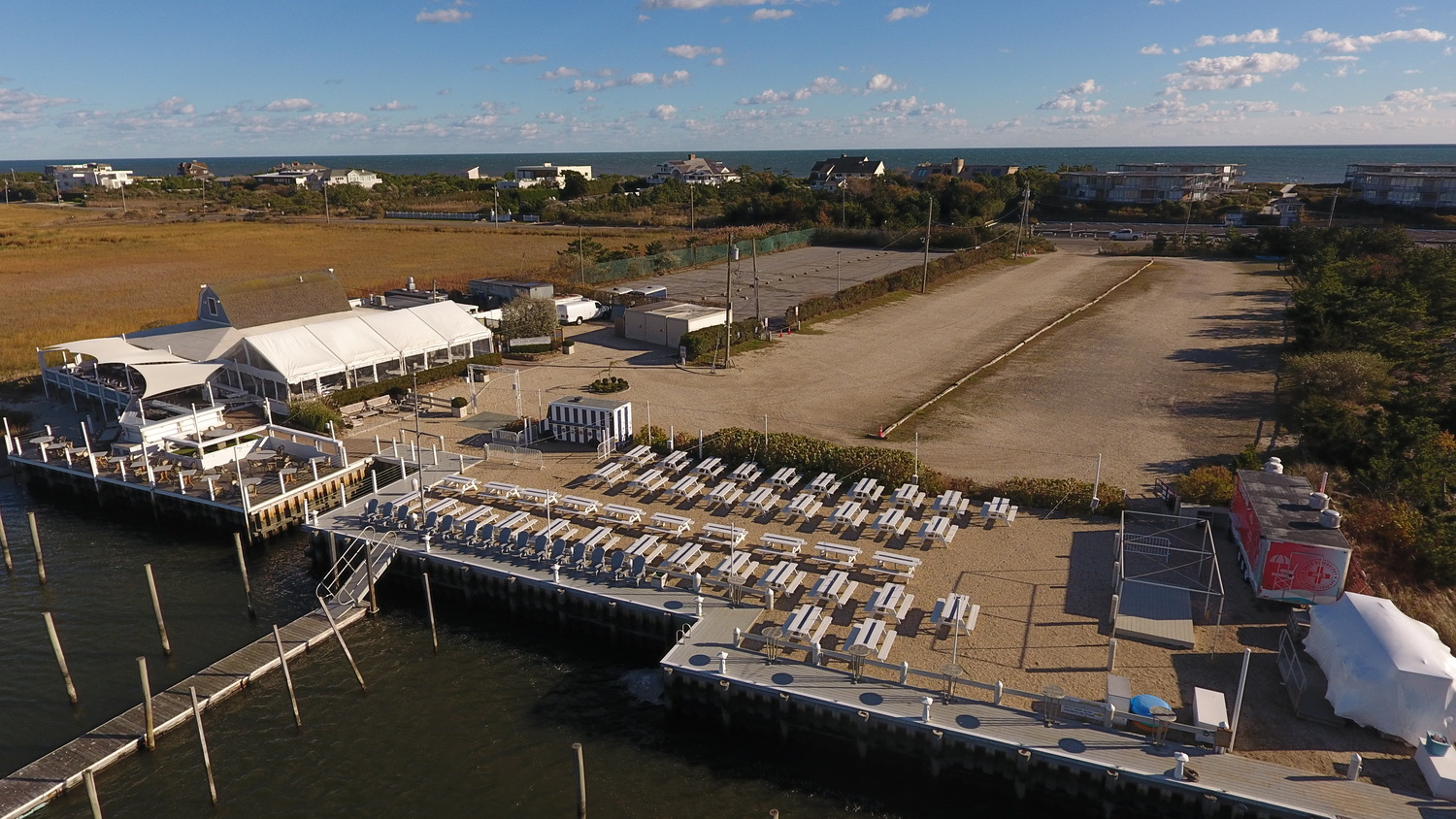
The owner of Dockers Waterside restaurant on Dune Road in East Quogue has proposed tearing down the restaurant and building 25 townhouse condominiums. Neighbors and environmentalists have pleaded with Southampton Town to reject the proposal and purchase the land with preservation funds.
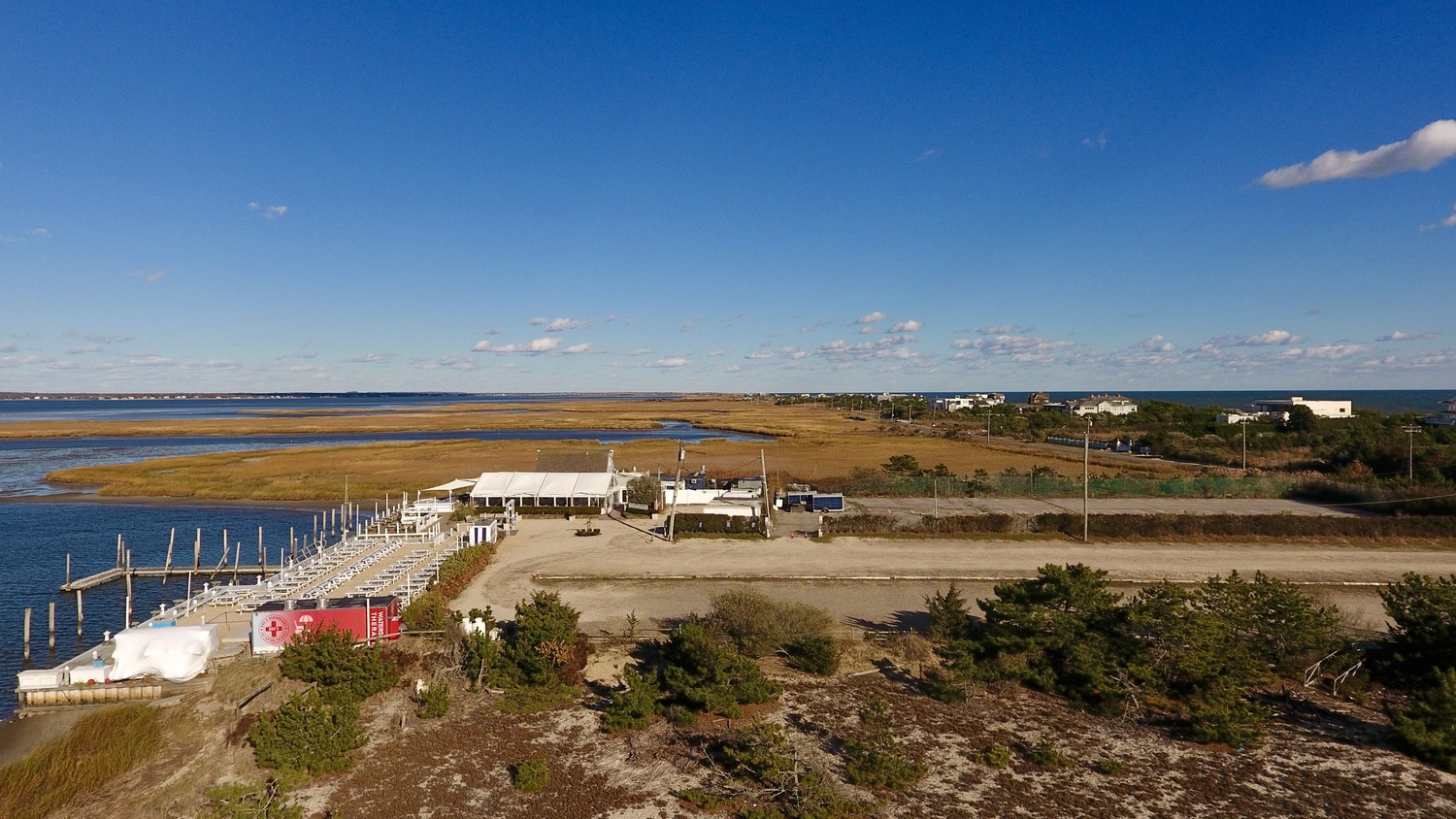
The owner of Dockers Waterside restaurant on Dune Road in East Quogue has proposed tearing down the restaurant and building 25 townhouse condominiums. Neighbors and environmentalists have pleaded with Southampton Town to reject the proposal and purchase the land with preservation funds.
Residents of East Quogue this past week leveled harsh assessments of the latest evidence in support of a proposal to build a 25-unit condominium at the site of Dockers Waterside restaurant in East Quogue — calling claims that the development would be an environmental benefit over the current use demonstrably false.
The chorus of critics who spoke at the hearing said the condominium proposal violates the existing zoning and the town’s long-term planning recommendations for the area, would add to water quality challenges in the already-impaired western Shinnecock Bay and would be a scar on one of the most scenic stretches of tidal marshlands in the town.
“This would pose a significant ecological threat to our area — the wetlands are crucial to maintaining the health of our waters and supporting the diverse wildlife and flora,” Susanne Jansson, an East Quogue resident, said. “The density would exacerbate existing challenges on Dune Road, which is already susceptible to increasing storms and rising sea levels. The site can at most support one or at most two homes, not a 25-unit condominium with parking for 45, as well as pool, tennis court and septic system.”
“I take my kids there to see the beauty of nature — to take them there and look up at a building, we might as well be in New York City,” Christina Richman, a Quogue resident, said. “We have enough building here … we have enough big homes, enough fences around our yards. … We need to preserve what we have and appreciate it. It’s not being appreciated. It’s being looked at monetarily, like, ‘What can we get for this?’”
The condo proposal has been brewing before the Planning Board and Zoning Board of Appeals since 2020. Back in May, representatives of Dockers owner Larry Hoffman presented the Planning Board with the draft environmental impact statement, or DEIS — a state-mandated assessment of the project and its potential impacts that took more than a year to compile.
After numerous delays, the Planning Board finally held its public hearing on the findings of the impact statement on Thursday, October 23.
The comments garnered at the hearing were supposed to focus on the details of the project’s impact laid out in the EIS, so that the applicant can go back and address them in the document before the Planning Board adopts it as the final assessment of the project.
Hoffman’s attorneys and consultants have claimed in their extensive detailing of the proposal that the condo development would be less impactful on the area than the restaurant currently is. They say that the amounts of nitrogen that will seep into the tidal waters, feeding harmful algae blooms, will be far lower from the residences, thanks to the sewage treatment system they have proposed installing, compared to the current restaurant’s cesspools, which sit in groundwater and offer zero nitrogen filtering from the wastewater flushing out of the restaurant’s toilets.
They extolled the benefits of shifting the development on the property away from the waterfront because the new building will be moved landward by 100 feet. And they say the residences will mean far less vehicle traffic along the roadway in the high season than the busy restaurant brings now.
The zoning on the property is officially for residential use but allows only development of one single-family home, or perhaps two, on the approximately 8.5-acre parcel. The restaurant, which was built before the zoning was changed, may remain indefinitely as a “preexisting, nonconforming” use.
Hoffman has proposed 25 townhouse-style condominiums, spread over four separate two-story structures, with a common swimming pool area surrounded by new decking. The existing marina would become private dockage for the residents.
If the condo project is not approved, Hoffman has said a 2014 court ruling appeared to give him the right to install gas pumps and up to 60 slips at the marina — something he had proposed decades ago himself but shelved after years of back-and-forth negotiations with the Southampton Town Trustees. A future owner could force through a new version of the marina, without ending the restaurant use or upgrading the septic systems, he has said.
The application to the town asks the Zoning Board of Appeals and Planning Board to allow Hoffman to change the property use from one nonconforming use to another nonconforming use and argues that he should be allowed to do so on the basis that the shift will be to the greater overall benefit of the community.
None of those who spoke at Thursday’s hearing saw it that way.
“Why would you bring a plan that is even more nonconforming with [what] is there now?” Anne Algeri, the former longtime leader of the East Quogue Civic Association, said. “I’ve seen the drawing of what’s proposed, in my view, it belongs in Canarsie, not Southampton Town.”
“What is the insanity here that you think it’s okay to approve the construction of such a large facility on such a precious piece of land?” echoed Deborah Disston, a Quogue resident. “I ask that you stop this incredibly selfish group of people.”
Seasoned professionals put a less emotional, more legal, spin on their criticisms.
“The current use is an artifact of development long before local governments understood or valued the long-term implications of shoreline development,” Robert DeLuca, the president of the Group for the East End, the region’s oldest environmental advocacy organization, said.
“As early as 1972 the Town of Southampton began to come to terms with the consequences of shoreline development and rezoned the property. That was more than 50 years ago.
“So we urge the board to reject the present proposal, explore preservation and seek an alternative that far more closely resembles the low-density underlying zoning that the town has intended for this site for more than 50 years,” he said.
But ridding the property of all development would be the most environmentally responsible way forward, DeLuca said. “The best long-term outcome for this parcel is the purchase for preservation,” he said.
Hoffman and Southampton Town have discussed the purchase of the property using Community Preservation Fund revenues before the condominium proposal was advanced — but Hoffman says the offer the town made was barely more than one-fifth of what the property appraised for at the time.
The most robust takedown of the claims in the application’s EIS came from attorney Greg Kalnitsky, who was hired to oppose the condo project by billionaire grocery store magnate John Catsimatidis, who owns a home near the Dockers property.
Kalnitsky said the DEIS presented to the Planning Board was more sales pitch in favor of the project than a detailed breakdown of the potential impacts of the project, as the state mandates dictate an EIS to be.
“This document is supposed to analyze in an impartial way any potential significant adverse impact of a development. Then it’s supposed to analyze how to mitigate or avoid those impacts,” said Kalnitsky, who presented the Planning Board with an extensive written rebuttal to the EIS conducted by his own team of engineers. “It’s not supposed to present the project spun in the best light possible. It’s not supposed to omit information that isn’t favorable.”
The attorney said that benefits of the large residential development connected to a sewage treatment system, compared to the existing restaurant continuing to use its cesspool, were grossly distorted in the DEIS because it projects the peak septic output of the restaurant throughout the year — even though the actual water usage at the seasonal restaurant is drastically lower. He also noted that ample grant money is available from Southampton Town and Suffolk County to fund connecting the restaurant to a nitrogen-reducing septic system.
The DEIS references the neighboring Round Dune condominiums as justification for being allowed to build the new condo complex across the street. But Kalnitsky noted that when Round Dune’s four condo buildings were built, such structures were allowed as of right. “That has long since changed — because the area is not suitable for it,” he said.
He also pointed to another development the application had pointed to as a would-be parallel: the conversion of the former Salty Dog restaurant on the corner of Noyac Road and Long Beach into condominiums in the early 2000s. But that comparison is not apples to apples, Kalnitsky said.
“The Salty Dog was not in wetlands, in an environmentally sensitive zone — this project is. The Salty Dog required limited site alteration, whereas here we need to truck in tons of fill and raise elevation of the entire parcel by several feet to even make it buildable. The Salty Dog reduced the square footage of the existing building — this application is enlarging it … The Salty Dog reduced the lot area coverage — this increases it.”
The extent to which building the condo project would require a massive remaking of the property should be evidence enough it should not get further consideration, he said.
“If you have to truck in over 100 trucks of soil just to make a site buildable, that site is not appropriate for that type of development,” he said.


 Michael Wright on Nov 8, 2025