


 1 Photo
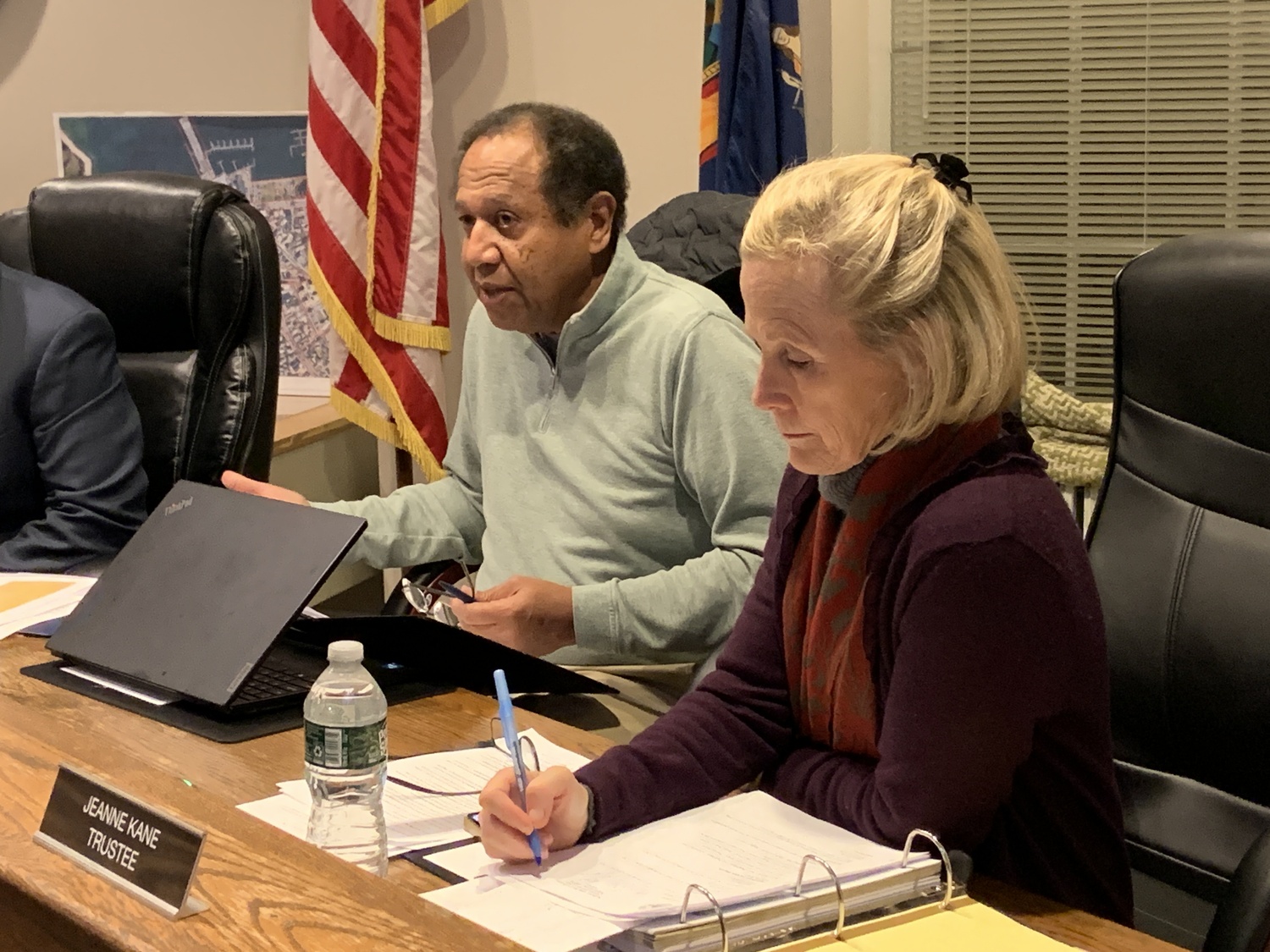
Sag Harbor Village Trustee Ed Haye, left, discusses the village's use of parking revenue to underwrite planning studies at Tuesday's Village Board meeting. Trustee Jeanne Kane looks on. STEPHEN J. KOTZ
Members of the Sag Harbor Village Board have long cited the need for objective data before they can tackle any number of issues facing the village — from parking improvements to the need for a new firehouse. On Tuesday, December 9, the board passed four resolutions that will use money earned from paid parking and ticket revenue to underwrite the cost of studies it says are necessary before it can take action on many fronts.
Trustee Ed Haye, who serves as the deputy mayor under Mayor Tom Gardella, described the studies, which will cost in total $292,900, with an additional $50,000 having been earmarked in August to study the Route 114 corridor, as “strategic investments” in the village’s infrastructure without relying on village taxpayers to cover the cost.
The largest share, $179,500, will be paid to H2M Architects and Engineers to plan for the moving of the village’s Department of Public Works from its current location off Columbia Street and Brick Kiln Road to village-owned property at the Sag Harbor transfer station on the Bridgehampton-Sag Harbor Turnpike. That study will also include “schematic design” and prebond services needed before the village can move forward with plans to replace its existing emergency services buildings at the Columbia Street site.
An additional $21,500 will be earmarked for the Raynor Group, an engineering and surveying firm, to survey, map and oversee the planning and permitting required to subdivide a portion of the village’s property on the turnpike for a future home for the Department of Public Works.
Yet another measure earmarks $57,000 to be paid to LKMA, an engineering firm, to undertake a comprehensive study of the village’s parking inventory, demands on that inventory and potential solutions to the village’s nettlesome parking issues.
A fourth measure calls for LKMA to undertake a villagewide transportation plan, using data collected from various village streets, at a cost of $34,900.
Haye said the village currently spends about $820,000 per year to operate its justice court and pay for the police department’s traffic control officers. With revenue surpassing $1 million, mostly from parking tickets, the village is able to pay for its traffic enforcement and have money left over to support the infrastructure spending.
Paid parking on Long Wharf, the Meadow Street lot, and the gas ball lot generated nearly $221,000 last year, which provides the village with another source of revenue to underwrite other projects. Besides the $57,000 earmarked for the parking study, the village will use $50,000 from the parking revenue to replace a 30-horsepower drainage pump near the Beacon restaurant. Additional money from the parking revenue is usually used to cover the cost of the village’s annual sidewalk repairs.
Since most parking tickets are issued to nonresidents, Haye said the village is able to rely on outsiders who use the village’s parking assets to fund improvements.
He added that the village’s long-term plan is to continue to use nontax revenues to underwrite planning studies. The studies, in turn, can be used to help the village obtain the kind of large grants that are required for projects like sewer line expansion and the construction of a new firehouse.
Trustee Bob Plumb questioned whether it was wise to undertake another parking study. “We’ve counted the parking spaces in this village four times,” he said, adding that perhaps the money would be better spent in launching a comprehensive plan.
But other board members said work on the comprehensive plan would begin early next year, once the state signs off on the project, and the parking study could be folded into the plan.
“Every planning study we do feeds into the comprehensive plan,” Haye said.
Trustee Aidan Corish said he believed the various studies would bear valuable fruit as the village tries to tackle problems long into the future.
Corish said that in the past, the village had used “a scattershot approach” to strategic issues. “This is a great start,” he said. “This is sort of a new chapter for us.”
Without the studies, he said “we’ll just go around in circles again.”
Both Corish and Haye said having the studies in hand would help the village obtain more grant money to help it finance major improvements.


 Stephen J. Kotz on Dec 9, 2025