


 2 Photos
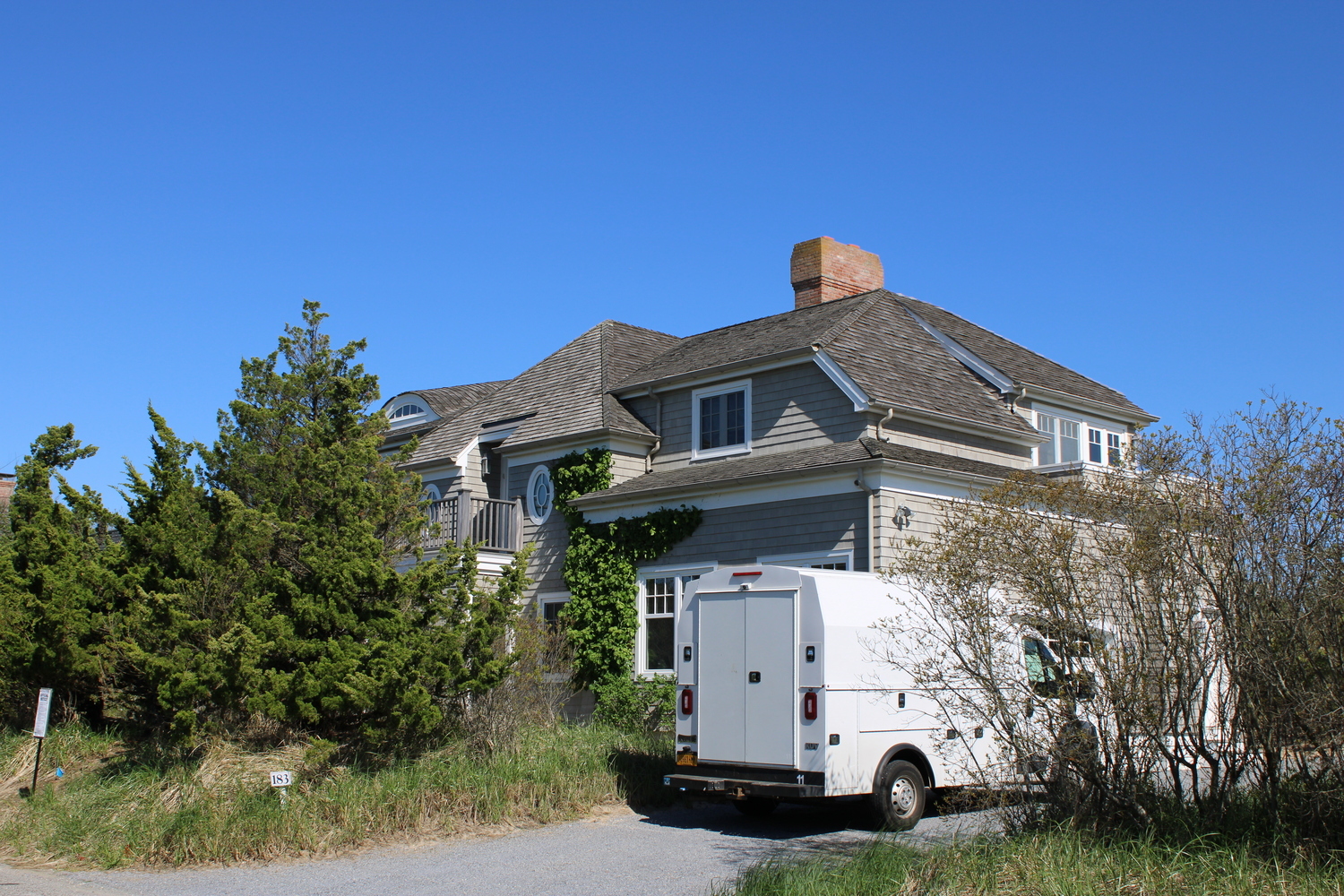
The house on Marine Boulevard back in May. JACK MOTZ

The Marine Boulevard homeowner applied to the East Hampton Town Zoning Board of Appeals for a set of renovations that it said would make the house FEMA-compliant, but neighbors pushed back. JACK MOTZ
An oceanfront homeowner on Marine Boulevard in Amagansett has sued the East Hampton Town Zoning Board of Appeals over a denial that the homeowner’s attorney suggests could imperil the home.
The ZBA moved last month to deny a special permit and seven variances for the Belsky family, who were looking to conduct a string of renovations that would, among other changes, make their home FEMA compliant. In all, the project would raise and renovate the existing house on the property with an eye toward FEMA guidelines.
But those in opposition, including a platoon of neighbors, said the renovations would create a pair of skyscrapers in Beach Hampton that would irreparably change the character of the neighborhood.
Constructed in accordance with FEMA guidelines in 2008, new regulations, passed in 2009, quickly erased the house’s compliance, said Christopher Abbott, the homeowners’ attorney, in Suffolk County Supreme Court papers filed on Monday.
“Petitioner’s application to the Zoning Board for the NRSP and variances was motivated not by a desire to further develop or build upon the premises, but instead to become FEMA compliant and simply raise the house and guest house on the premises to elevations required in current FEMA regulations,” said Abbott, referring to a natural resources special permit. “Aside from raising the structures, the application involved virtually no additions to them aside from several minor modifications.”
Abbott said the requested variances were the minimum required to reach FEMA compliance, and denial, per Abbott, amounts to the ZBA telling the Belsky family to demolish their house and build it anew or await destruction from the elements.
And he addressed the variance for maximum house size, purporting that the actual footprint of the house would not expand, despite the calculation increasing.
Combined, the main house and an attached cottage measure 4,563 square feet, just above the maximum allowable size for that lot, 4,522 square feet. A garage is built into the main residence, and since it is smaller than 600 square feet, it is exempt from the calculations, Abbott said.
Lifting the main house would mean that the garage is no longer used as a garage, and thus, it would no longer be exempt from the maximum house size calculation, notching the total house size up north of 5,000 square feet — or around 500 feet over the maximum. Abbott argued that this doesn’t amount to an addition.
As for the neighbors, Abbott noted that those immediately east and west of the property had expressed support for the application.
“To the extent the grant of these variances would have any impact on the neighborhood, those impacts would be felt the most by the immediately adjacent neighbors, who had offered their support to the application,” he said.
Among Abbott’s thoughts on the critiques: There was no evidence that the FEMA guidelines should be disregarded, none that approval would have an adverse impact on the neighborhood and none that it would harm the environment.
And he said the ZBA ignored the fact that the Belsky family would raise the structure to the minimum height necessary to attain FEMA compliance.
“The Zoning Board suggests the applicant should look at alternatives,” Abbott said. “The only alternatives to the applicant involve either removing significant portions of the residence while raising it, or awaiting its destruction through natural forces and becoming FEMA compliant on a rebuild.”
Town officials were off on Tuesday due to Election Day, and thus, did not fulfill a request for comment.
Abbott said he thinks the petition speaks for itself, but he added that he looks forward to asserting and protecting his client’s rights in the interest of protecting their community and their property.


 Jack Motz on Nov 5, 2025