


 1 Photo
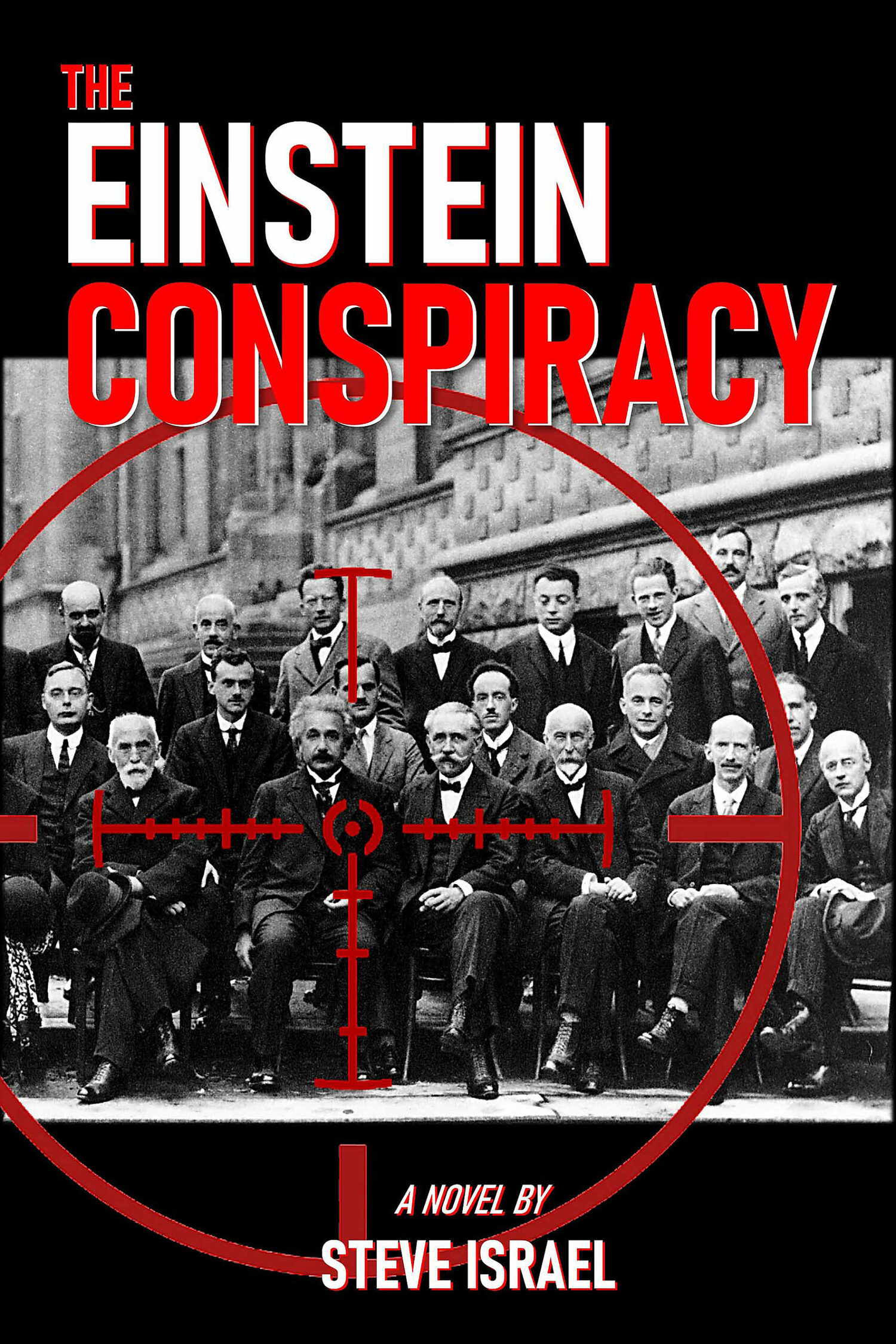
Steve Israel's new novel is “The Einstein Conspiracy.”
What a clever hoot — a historical thriller where everyone knows what happened but keeps turning the pages fast. What former U.S. Representative Steve Israel pulls off in “The Einstein Conspiracy” is a tale based on facts about Nazi sympathizers on Long Island and on Third Reich plans to make the first atomic bomb.
Israel, who served as a member of the House from New York’s 2nd Congressional District from 2001 to 2017, published two well-received political satires before he decided to turn his hand to spinning real-life events as fiction, specifically, the events leading up to the July 12, 1939 Albert Einstein–Leo Szlilard letter to President Franklin Delano Roosevelt, urging the immediate development of an atomic bomb.
Einstein was living at the time in a cottage on Nassau Point, Long Island, known then as Little Hog Neck, 90 miles from Manhattan, jutting into Gardiners Bay. The Nazis had already made two attempts to assassinate him abroad and now thought they could pull off a kidnapping thanks to an emboldened community for a New Germany in Yaphank on Long Island where streets were named after Hitler, Goering and Goebbels, and a Nazi training camp for youth had been established.
Of course, those who lived on the North Fork of Long Island knew about their extraordinary summer guest and his dubious prowess as a sailor in his skiff called Tinef — Yiddish for “piece of junk.” Israel has a good time playing with the great man’s rescue-laden passion for sailing, which had led to his being banned from the waters around Princeton. Folks on the North Fork also knew about the friendships Einstein struck up in town, particularly with the owner of Rothman’s Department Store in Southold who joined him in string recitals.
“The Einstein Conspiracy” is charming as it is suspenseful. It is also significant as background to the creation of J. Robert Oppenheimer’s Manhattan Project. When Leo Szilard, the Hungarian physicist, conceived nuclear chain reaction in 1933 and convinced Einstein that the Nazis were on their way to an atomic bomb, they sent a letter to FDR about the need for America to move forward immediately. For both men, pacifists at heart, it would be a turning point in world events.
But why a novel? Without saying so directly, Israel may well have had history in mind, given the recent, frightening upsurge here and abroad of antisemitism. Einstein had had to flee, as he finally did to America with his wife, Elsa, and personal secretary-assistant, Helen Dukas, thinking he would not encounter hatred of Jews. He was disconcerted to find the extent of Nazi support on the East End, but much to the dismay of local police and the FBI, he refused to take precautions. Indeed, he would sneak out to go sailing and wander about in town.
“It was,” as Israel writes, “as if the great man were himself Schrödinger’s cat, neither here nor there at any given moment, bending the rays of the sun itself to evade their surveillance.”
The statement is illustrative of Israel’s style — sentences advancing the plot that incorporate references to science, such as The Schrödinger’s Cat paradox, a thought experiment in quantum physics.
Israel knows how to marshal successfully the other aspects of fiction as well. He creates two unusual good guy FBI agents, Harry Weiss, Jewish, and James Amos, Black, who are determined to protect Einstein and catch his potential killer. Persistent, honorable, compassionate — will they be a match for the notorious Anton Gunther, a highly trained assassin posing as a Jew, sent by the führer himself to kidnap Einstein? A psychopath, Gunther himself is a fascinating character.
The ending is ingenious, courtesy of Professor Einstein himself. And timely in its expression of what the great man saw as a “fundamental law” of science worth recalling today when science and the scientific method both are subject to denial: “A theory doesn’t become truth until proven. It is simply a falsifiable hypothesis that must be confirmed through repeated challenge, experimentation, observation. Consistently supported as new evidence emerges.” Amen.
N.B.: Steve Israel is not only a talented author but the only known former congressman to open an independent bookstore — Theodore’s in Oyster Bay, named for the 26th U.S. president.


 Joan Baum on Dec 8, 2025